
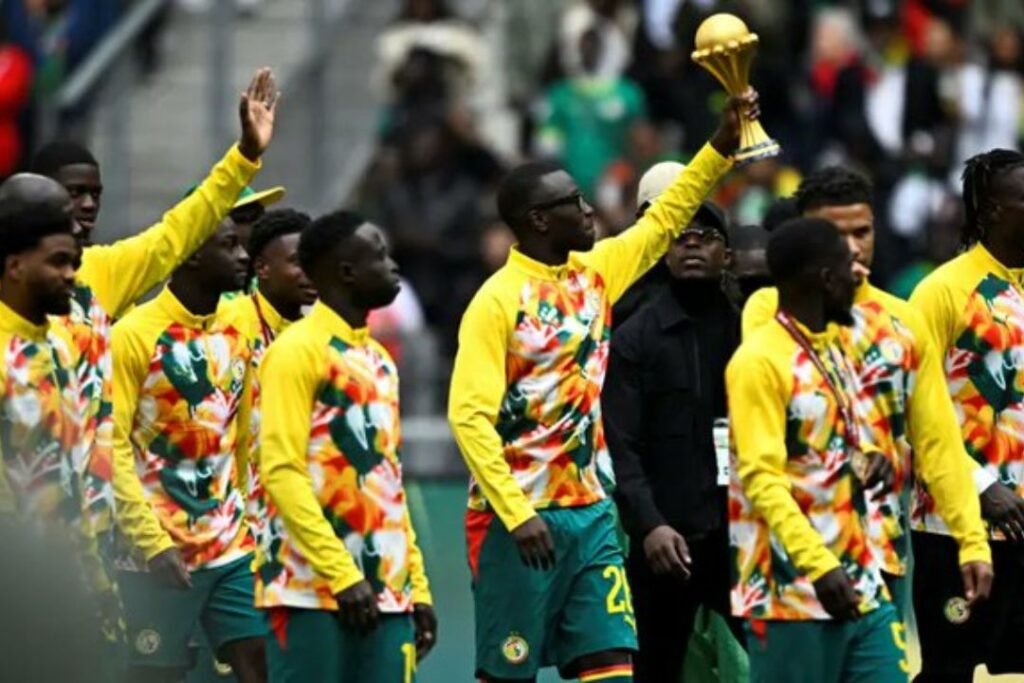
Senegal Defiantly Parades AFCON 2025 Trophy in Paris Despite CAF Stripping Title in Controversial Ruling
In a powerful display of defiance and national pride, Senegal’s national football team paraded the Africa Cup of Nations (AFCON) 2025 trophy around the pitch at Stade de France before their international friendly against Peru yesterday, drawing thunderous applause from a near-capacity crowd despite the Confederation of African Football (CAF) stripping them of the title just weeks earlier.
The Teranga Lions went on to defeat Peru 2-0 in the World Cup warm-up match, with goals from Ismaïla Sarr and Nicolas Jackson, but the pre-game trophy parade stole the headlines as a bold symbol of resistance against what Senegal views as an unjust ruling.
The Chaotic Final and CAF’s Controversial Decision
The controversy traces back to the AFCON 2025 final on January 18 in Rabat, Morocco, between hosts Morocco and Senegal. The match was scoreless deep into stoppage time when referee Jean-Jacques Ndala, following a VAR review, awarded Morocco a penalty for a challenge by Senegal’s El Hadji Malick Diouf on Brahim Díaz.
Incensed by the decision – which many described as harsh – Senegal’s players and coach Pape Thiaw walked off the pitch in protest, causing a 15- to 17-minute delay. Captain Sadio Mané eventually persuaded his teammates to return. Díaz then stepped up and missed the penalty with a poorly executed Panenka attempt, which goalkeeper Édouard Mendy saved comfortably. The game proceeded to extra time, where Pape Gueye scored the winner, handing Senegal a 1-0 victory on the field and what appeared to be their second AFCON title after 2021.
Morocco’s football federation (FRMF) appealed the result, arguing that Senegal had violated competition rules by leaving the field. On March 17, 2026, CAF’s Appeal Board upheld the protest, declaring that Senegal had “forfeited” the final under Articles 82 and 84 of the AFCON Regulations. The body rewrote the result as a 3-0 win for Morocco, crowning the Atlas Lions as champions for the first time since 1976 and stripping Senegal of the title.
In its official statement, CAF said: “The Senegal National Team is declared to have forfeited the Final Match… with the result of the Match being recorded as 3–0 in favour of the Fédération Royale Marocaine de Football (FRMF).”
Senegal’s Strong Response: Appeal and Corruption Allegations
Senegal has vehemently rejected the ruling. The Senegalese Football Federation (FSF) described it as “unfair, unprecedented and unacceptable,” arguing it discredits African football. They promptly filed an appeal with the Court of Arbitration for Sport (CAS) in Switzerland, seeking to have the original on-field result reinstated and Senegal declared champions. Meanwhile, CAS has confirmed receipt of the appeal.
The Senegalese government went further, calling for an “independent international investigation” into alleged “suspected corruption” within CAF’s governing bodies. Officials have spoken of “administrative robbery” and indicated they possess evidence warranting corruption charges against certain individuals.
CAF President Patrice Motsepe has stated that the organization will respect any final CAS decision, while emphasizing that all member associations have the right to appeal.
Symbolic Defiance in Paris
Despite the ongoing legal battle, Senegal chose to celebrate their on-field achievement publicly. An hour before kick-off against Peru, players and coach Thiaw carried the AFCON trophy around the Stade de France pitch to rapturous scenes from Senegalese fans. The gesture underscored their refusal to accept CAF’s decision as final and served as a morale boost ahead of the 2026 FIFA World Cup, where Senegal will compete for the third consecutive time.
The friendly itself passed without major incident, providing valuable preparation time as the squad focuses on June’s global showpiece.
Broader Implications for African Football
This saga has ignited fierce debate across the continent. Critics accuse CAF of undermining the integrity of the competition and setting a dangerous precedent by overturning an on-field result months later. Supporters of the ruling argue that rules on forfeiture must be applied consistently to maintain discipline.
The case highlights longstanding questions about refereeing standards, VAR usage in high-stakes African matches, and the impartiality of CAF’s disciplinary processes – especially when host nations are involved.
