
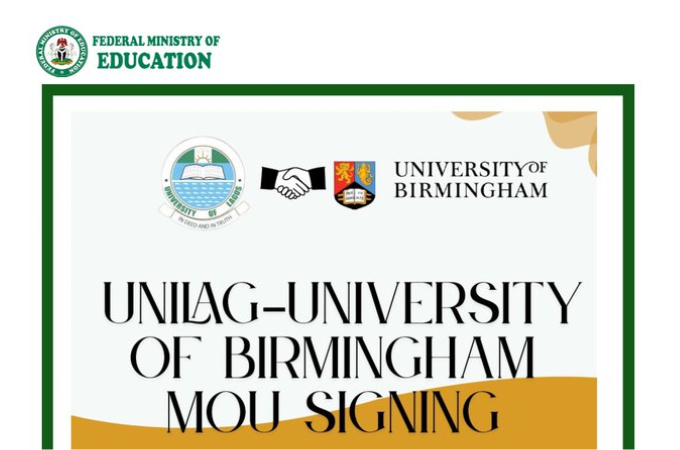
Nigeria, University of Birmingham Sign Landmark UK Russell Group Education Pact
To advance Nigeria’s higher education sector, the Federal Government has facilitated the signing of a Memorandum of Understanding (MoU) between the University of Lagos (UNILAG) and the University of Birmingham, a member of the United Kingdom’s prestigious Russell Group of research-intensive universities.
The agreement, announced today by the Honourable Minister of Education, Dr. Maruf Tunji Alausa, marks the first time an African nation has established a transnational education (TNE) model in collaboration with a Russell Group institution.
At a Glance: The UNILAG-Birmingham Partnership
-
Signatories: University of Lagos (Host) and University of Birmingham (UK Partner).
-
Accreditation: World-class UK-accredited degrees delivered on Nigerian soil.
-
Initial Focus: Postgraduate STEMM fields (AI, Robotics, Data Science, Life Sciences).
-
Strategic Goal: Retain talent in Nigeria and reduce foreign exchange outflows for international study.
Scope and Focus of the Transnational Education Framework
The TNE framework will initially emphasize postgraduate programmes in high-demand STEMM fields, including Artificial Intelligence, Robotics, Engineering, Life Sciences, and Data Science. Plans indicate a balanced structure with approximately 50% undergraduate and 50% postgraduate offerings once fully implemented. Students completing these programmes will earn degrees from the University of Birmingham, delivered through UNILAG as the host institution, potentially under models such as joint certification or dual awards.
This partnership builds on more than a decade of collaboration between UNILAG and the University of Birmingham, particularly in global surgery research through initiatives such as the NIHR Global Health Research Unit.
What is the Russell Group?
The Russell Group represents 24 of the UK’s leading public research universities, often referred to as the “Ivy League” of the United Kingdom. These institutions receive approximately two-thirds of all university research grant funding in the UK. By partnering with Birmingham, Nigeria is aligning its domestic academic standards with a group that includes Oxford, Cambridge, and Imperial College London. This MoU is a strategic move to benchmark Nigerian graduates against the highest global standards.
Historical Path and Strategic Objectives
Discussions toward this partnership began as early as May 2025, with high-level meetings in the UK and Nigeria. By October 2025, focus shifted to finalizing arrangements, including a visit to the University of Birmingham’s Dubai campus. The January 2026 signing represents the culmination of these efforts, following earlier announcements of a planned “UNILAG-Birmingham Transnational Education Campus.”
The initiative aligns with President Bola Ahmed Tinubu’s Renewed Hope agenda and the Nigeria Education Sector Renewal Initiative (NESRI). It addresses critical challenges:
-
High outbound student mobility: Significant foreign exchange outflows.
-
Brain Drain: Retaining top-tier talent within Nigerian borders.
-
Economic Growth: Building a skilled workforce for the ambition of a $1 trillion economy by 2030.
Broader Significance for Africa
The partnership positions Nigeria as a pioneer in transnational education on the continent. British institutions are increasingly prioritizing collaborative models in countries like Nigeria to export education without relying solely on inbound international students.
Public reactions have been largely positive, though some observers have called for faster improvements to domestic university infrastructure to match the prestige of the partner institution. As details of program launches, admission processes, and fees emerge, this MoU is poised to set a precedent for future international collaborations in African higher education.
