
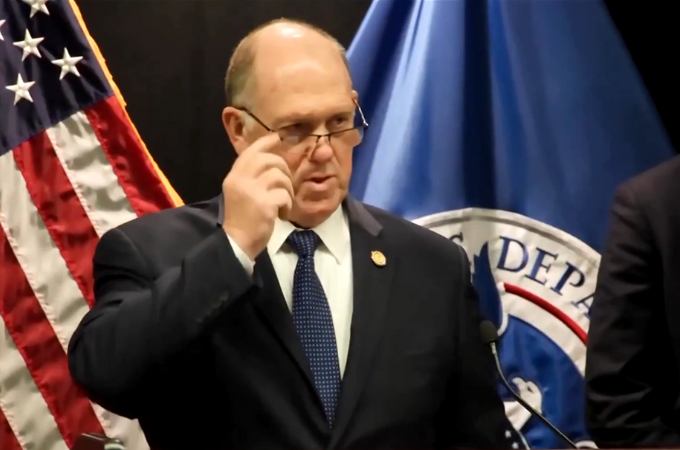
Homan Outlines Strategic Shift to Targeted Enforcement in Minneapolis
White House Border Czar Tom Homan held a high-stakes press conference on Thursday morning, January 29, at the Whipple Federal Building, signaling a significant tactical shift in the federal government’s immigration enforcement operations in Minnesota.
Addressing reporters for the first time since arriving to oversee Operation Metro Surge, Homan announced a transition toward “targeted, strategic enforcement operations” and outlined a plan to reduce the 3,000-strong federal force if state and local authorities increase their cooperation with federal agencies.
The “Targeted Enforcement” Framework
Homan struck a diplomatic yet firm posture, wearing a dark suit and emphasizing a “by the book” approach. He acknowledged that federal operations in the Twin Cities had not been “perfect” and required immediate improvements to safety and efficiency.
Key Strategic Updates:
-
Priority Targets: Enforcement will focus exclusively on “criminal aliens, public safety threats, and national security threats.”
-
Jail Access: Homan requested that ICE be granted greater access to county jails to take custody of “violent illegal aliens” upon their release, arguing that “more agents in the jail means less agents on the street.”
-
Conditional Drawdown: The redeployment of federal agents out of Minnesota is “dependent upon cooperation” from state leaders, specifically regarding the honoring of ICE detainers.
-
Internal Reform: A newly issued memo directs federal officers to refrain from unnecessary communication with “agitators” to avoid inflaming community tensions.
Operation Metro Surge Casualties
The catalyst for Homan’s deployment to Minneapolis was a pair of fatal shootings involving federal agents that ignited nationwide outrage. On January 7, Renee Good, a 37-year-old mother of three, was killed by an ICE agent. This was followed on January 24 by the fatal shooting of Alex Pretti, a 37-year-old intensive care nurse, during a protest. While administration officials initially characterized the victims as “domestic terrorists,” verified video evidence has led to calls from Minnesota Attorney General Keith Ellison for a joint state-federal investigation into the use of lethal force. Homan’s arrival coincided with the removal of Border Patrol Commander Greg Bovino, who was the face of the previous “aggressive” tactical phase.
Federal-State Coordination
Following what he described as “very productive” meetings with Governor Tim Walz, Attorney General Keith Ellison, and Mayor Jacob Frey, Homan noted a breakthrough in information sharing. Ellison reportedly agreed that county sheriffs would notify federal authorities of the release dates for “criminal public safety risks.”
Homan used the platform to contrast current border conditions with those of the previous four years, citing:
-
Human Trafficking: Alleging that sex trafficking of women and children reached all-time highs under the prior administration.
-
Fentanyl Crisis: Attributing approximately 250,000 American deaths to fentanyl smuggling.
-
Migrant Mortality: Pointing to a “historic record” of over 4,000 deaths during border crossings from 2021 to 2024.
“We are not surrendering the President’s mission,” Homan warned. “We’re just doing it smarter.”
Public and Political Reaction
While state leaders acknowledged the improved dialogue brought by Homan’s arrival, Mayor Jacob Frey expressed deep skepticism regarding the promised drawdown, stating, “I’ll believe it when I see it.” Local advocates continue to demand an end to masked agents on the streets and the implementation of body cameras for all federal officers involved in Operation Metro Surge.
Homan concluded the briefing by emphasizing that while “worst of the worst” criminals are the priority, individuals in the country illegally are “never off the table” for removal.