
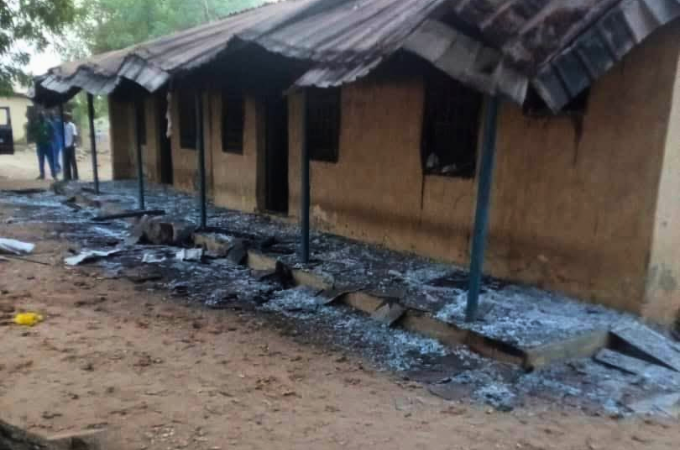
Bandits Overrun Police Station in Agwara: Church Torched and Five Abducted
Suspected armed bandits launched a devastating overnight assault on Agwara town, the headquarters of Agwara Local Government Area, early Sunday morning, February 1, 2026.
The attackers overwhelmed local security forces, utilizing explosives to destroy the divisional police station and setting fire to a local church before abducting five civilians. The raid, which began around 3:40 a.m., resulted in at least one confirmed fatality as gunmen on dozens of motorcycles swept through the community.
Niger State Police Command spokesperson SP Wasiu Abiodun confirmed that tactical officers engaged the assailants in a fierce gun battle but were ultimately “overwhelmed” by the superior numbers of the terrorist group. The attackers reportedly used dynamite to blow up the police facility, leaving the station in ruins. Following the destruction of the outpost, the bandits targeted the United Methodist Church of Africa (UMCA), torching portions of the building and spreading panic throughout the predominantly Christian community.
Why It Matters: Governance Gaps and Tactical Vulnerability
The overrunning of a local government headquarters’ police station signals a critical failure in the rural security architecture of North-Central Nigeria. By successfully neutralizing a divisional outpost with explosives, bandits have demonstrated a tactical evolution from simple hit-and-run kidnapping to high-intensity urban assault. This incident highlights the “security vacuum” in border regions, where state forces struggle to maintain a permanent presence against highly mobile, loosely affiliated criminal gangs.
For the residents of Agwara, the destruction of the primary police facility removes the last line of formal protection, likely leading to further mass displacement toward larger urban centers. Strategically, the use of explosives and the targeting of religious infrastructure suggest an intent to not only seize hostages for ransom but to psychologically destabilize the region and degrade state authority.
Strategic Context: A Corridor of Violence
The Kainji National Park Security Crisis
The Agwara raid is the latest in a series of escalations centered around the Kainji National Park corridor. This vast, ungoverned forest serves as a primary hideout for bandit groups operating across Niger and Kebbi States.
Recurrent Attacks: This same group is suspected of carrying out the “New Year’s Day Massacre” in Kasuwan Daji, where 42 men were executed.
Tactical Patterns: Attackers consistently use motorcycles for high mobility and target police documents and communication equipment during raids.
Previous Abductions: The region is still reeling from the November 2021 abduction of 230 pupils and staff from St. Mary’s Catholic School in Papiri—all of whom were fortunately rescued by late December 2025.
A Community Under Siege
In Agwara, the sound of motorcycles has become synonymous with terror.
The abduction of five residents, believed to have been taken toward the forest hideouts of the Kainji Reserve, has renewed calls from local leaders for a permanent military task force.
Bishop Bulus Yohanna of the Kontagora Diocese emphasized the trauma of a community that is “roaming the bush at night” to avoid being caught in their homes. For many, the return to “normality” promised after the 2025 school rescues has been abruptly shattered by the smoke rising from the UMCA ruins.
