
Why the Occupy NASS Protest Matters: Peter Obi and CSOs Demand Real-Time Election Results Transparency
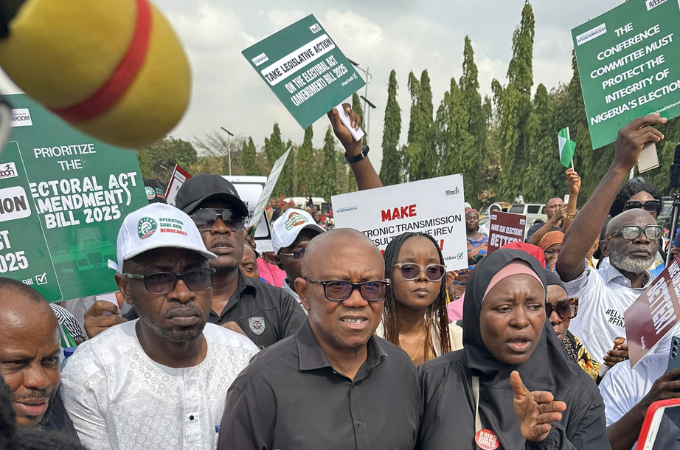
Former Labour Party presidential candidate Peter Obi joined the Occupy National Assembly protest in Abuja on Monday, February 9, 2026, to demand that the Senate explicitly include mandatory real-time electronic transmission of election results in the ongoing amendments to the Electoral Act 2022.
The protest was organised in response to the Senate’s passage of the Electoral Act 2022 (Repeal and Reenactment) Amendment Bill 2026 through third reading on February 4, 2026. During the process, lawmakers removed the phrase “real-time” transmission of results, retaining the existing discretionary language that allows INEC to prescribe the method of transmission.
Obi, who has since joined the African Democratic Congress (ADC), addressed protesters at the National Assembly gate, urging lawmakers to prevent the kind of technical glitches INEC reported during the 2023 general elections. He insisted that real-time electronic transmission of results from polling units to INEC’s IReV portal must be made mandatory to ensure transparency and restore public confidence in the electoral process.
The protest, which began at the Federal Secretariat and marched toward the National Assembly entrance, included members of civil society organisations, opposition ADC members, women’s groups, and other concerned citizens. Participants carried placards and chanted slogans calling for electoral integrity and accountability.
There was a heavy security presence at the scene, with personnel from the Nigeria Police Force, Nigerian Army, and Nigeria Security and Civil Defence Corps deployed. Police barricaded the entrance to the National Assembly complex, but organisers stated the protest would remain at the gate and not attempt to enter the premises.
Obi and other protesters argued that the Senate’s decision to retain discretionary transmission undermines efforts to eliminate result manipulation between polling units and collation centres — a recurring allegation in past elections. They called on lawmakers to amend the bill to explicitly mandate real-time uploads before it proceeds to harmonisation with the House of Representatives version.
The Senate has issued multiple clarifications insisting that it approved electronic transmission, not rejected it, and that the wording was adjusted to avoid ambiguity. Senate President Godswill Akpabio and other leaders have maintained that the current framework, combined with BVAS accreditation, is sufficient and was successfully used in previous polls.
Civil society groups and election observers have expressed disappointment, arguing that mandatory real-time transmission would significantly reduce opportunities for tampering and boost transparency. The protest reflects growing public and political pressure ahead of the 2027 general elections.
The amended bill remains inconclusive pending adoption of the Votes and Proceedings and harmonisation between the two chambers. If passed and signed into law by President Bola Ahmed Tinubu, the changes will shape Nigeria’s electoral framework for the 2027 polls and beyond.
