
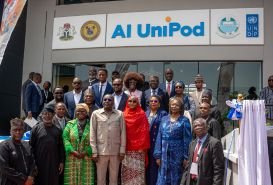
FG and UNDP Launch Nigeria’s First AI University Innovation Pod at UNILAG to Drive National Development
The Federal Government of Nigeria, working with the United Nations Development Programme and the Tertiary Education Trust Fund, has launched Nigeria’s first Artificial Intelligence University Innovation Pod at the University of Lagos.
The initiative, formally inaugurated on April 7, forms the cornerstone of a nationwide network of University Innovation Pods designed to convert academic institutions into hubs for entrepreneurship, job creation and technological advancement.
According to an official statement issued by the UNDP on the day of the launch, the AI UniPod at UNILAG serves as the national flagship for the programme, backed by more than ₦30 billion in public funding. It marks Nigeria as the first African country to adopt and scale the UNDP’s timbuktoo innovation model through direct government co-investment and coordinated policy support.
Vice President Kashim Shettima was represented at the ceremony by Senator Ibrahim Hassan Hadejia, Deputy Chief of Staff to the President, who conveyed the administration’s vision for universities to become active platforms for production and national development.
Senator Hadejia described the UniPods as essential components of a broader delivery system where students, researchers and industry experts collaborate to address real economic challenges. He stressed that the pods would shift universities from traditional centres of learning toward engines of enterprise and competitiveness.
UNILAG Vice-Chancellor Professor Folasade Ogunsola called the launch the start of a transformative process that would reshape scholarship and contribute to national progress, emphasising artificial intelligence’s potential to enhance human capabilities and solve complex problems.
The Minister of Communications, Innovation and Digital Economy, Dr Bosun Tijani, highlighted the need for universities to evolve into centres of creation and productivity. TETFund Executive Secretary Arc. Sonny Echono referred to the pods as “collision spaces” where ideas from academia meet industrial requirements.
Meanwhile, Lagos State Governor Babajide Sanwo-Olu, represented by Commissioner for Innovation, Science and Technology Olatunbosun Alake, welcomed the facility as a timely intervention that would bridge the gap between academic research and practical industry application.
The UNILAG AI UniPod will focus on frontier technologies, digital skills development, startup incubation and venture creation. It leads an initial rollout across Nigeria’s six geopolitical zones, with each pod aligned to specific priority sectors.
These include agriculture and food systems at Benue State University in Makurdi, resilience and recovery at the University of Maiduguri, manufacturing and trade at Michael Okpara University of Agriculture in Umudike, green and blue economy at the University of Uyo, mining technology and resource innovation at Nasarawa State University in Keffi, and industrial and government technology at Ahmadu Bello University in Zaria.
Additional pods, including one at a polytechnic, are planned for later phases, with the long-term target of establishing facilities in more than 50 higher institutions nationwide. Officials project that the network will train over 500,000 young Nigerians in advanced digital and innovation skills, support the creation of thousands of startups and generate scalable enterprises capable of contributing to national productivity.
UNDP Nigeria Resident Representative Elsie Attafuah described the programme as more than a collection of innovation hubs, framing it instead as a coordinated national system that integrates public investment with partnerships to deliver jobs and economic transformation.
The initiative directly tackles Nigeria’s demographic realities, where more than 60 per cent of the population is under 25. High youth unemployment and a persistent mismatch between educational outcomes and labour market needs have long been identified as major constraints.
By providing modern infrastructure, reliable connectivity, alternative energy solutions, mentorship and commercialisation pathways, the UniPods aim to close this gap and unlock the potential of the country’s youthful population. Minister of Education Dr Tunji Alausa, represented at the event, described the launch as a decisive step toward positioning Nigeria as a regional leader in digital innovation.
The programme aligns with President Bola Ahmed Tinubu’s Renewed Hope Agenda and complements existing efforts such as Community Innovation Centres and digital public infrastructure projects.
Informed observers view the UniPods as a strategic move to reduce dependence on imported technology and strengthen Nigeria’s industrial base. The emphasis on sector-specific innovation is expected to generate solutions tailored to local challenges in agriculture, manufacturing, mining and environmental management.
Early ventures emerging from the pods already indicate that commercial outcomes could materialise sooner than in many similar programmes elsewhere on the continent. Nigeria’s approach stands out for its whole-of-government coordination, involving multiple ministries and direct public financing.
This model differs from fragmented donor-driven projects by embedding innovation within national development priorities. Observers suggest it could serve as a blueprint for other African countries seeking to scale university-based innovation ecosystems.
As the flagship facility at UNILAG becomes operational, attention will turn to the pace of rollout across the designated institutions and the quality of collaboration between academia, industry and government. Stakeholders have expressed optimism that sustained funding and policy consistency will determine the long-term success of the network.
