
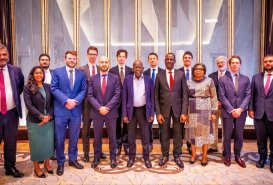
President Tinubu Pitches Nigeria’s Economic Reforms to Global Investors in Paris
President Bola Ahmed Tinubu has used an investor engagement in Paris to present Nigeria as a reformed and increasingly attractive destination for capital, pointing to exchange rate stability and strong economic growth in 2025 as evidence of the success of his administration’s key policy decisions.
The closed-door meeting, which took place on Tuesday, brought together senior representatives from major international financial institutions including Citibank, France’s Amundi, BlueCrest, Ninety One, Kirkoswald Capital, Principal Finisterre, Prudential Global Investment Management and Mesarete Capital. Tinubu was accompanied by Finance Minister and Coordinating Minister of the Economy Taiwo Oyedele.
In remarks shared widely on social media, President Tinubu described the economy he inherited as one that was on the brink of collapse and outlined the difficult but necessary steps taken to stabilise it. He singled out the removal of fuel subsidies and the unification of multiple exchange rates as pivotal reforms that have delivered greater transparency and improved returns on government bonds. “The subsidy that was a burden to the entire country was removed, and ever since today we’ve achieved the exchange rate stability,” Tinubu said.
He added that these measures had brought consistency and transparency to Nigeria’s fiscal management. Finance Minister Taiwo Oyedele reinforced the message with macroeconomic data, noting that Nigeria recorded 11.2 percent GDP growth in dollar terms in 2025.
According to the Minister, this performance strengthens the administration’s target of building a $1 trillion economy by 2030. Oyedele also pledged greater transparency through quarterly financial disclosures and emphasised the need to ensure that reforms deliver tangible benefits to ordinary citizens.
Independent assessments support the headline growth figures. Nigeria’s GDP expanded significantly in dollar terms in 2025, driven by a stronger naira, improved oil production and expansion in the non-oil sector. This outpaced many regional peers despite rapid population growth.
The Paris engagement forms part of a broader international outreach effort to rebuild investor confidence following the 2023 reforms. The removal of fuel subsidies, announced in Tinubu’s inaugural address, ended a long-criticised policy that had drained public finances and encouraged smuggling.
Official estimates put annual savings at around ₦10 trillion, although these have been partly offset by rising debt servicing costs and other expenditures. The unification of exchange rates aimed to eliminate arbitrage opportunities and rent-seeking behaviour.
Supporters argue the moves have improved fiscal discipline, boosted foreign reserves and created a more predictable environment for investment. Critics, however, have pointed to short-term hardships including higher fuel prices, elevated inflation and increased cost-of-living pressures.
