
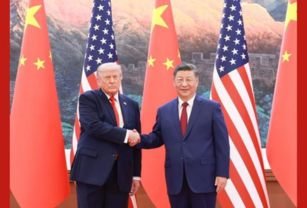
Trump Claims China Will Withhold Military Equipment from Iran After Beijing Summit with Xi
US President Donald Trump has stated that Chinese President Xi Jinping pledged during their meetings in Beijing not to supply military equipment to Iran.
The announcement came at the conclusion of the first full day of high-level talks between the two leaders, which also covered trade, energy and regional security concerns.
Trump described the discussions as highly productive while highlighting specific commitments from his Chinese counterpart. The talks took place against the backdrop of ongoing conflict involving Iran and marked Trump’s first visit to China since 2017.
Xi hosted a state banquet for the US delegation at the Great Hall of the People, where he described US-China relations as the world’s most important bilateral tie, representing a combined population of 1.7 billion people. Trump responded by calling the visit a great honour and extending an invitation for Xi and his wife to visit the White House in September.
Trump, speaking in a pre-recorded interview with Fox News host Sean Hannity that aired after the meetings, emphasised China’s position on Iran. He claimed Xi had made it clear that Beijing does not want Iran to acquire nuclear weapons and had committed to withholding military equipment. “He said he’s not gonna give military equipment. That’s a big statement,” Trump noted.
At the same time, the US president acknowledged China’s continued interest in purchasing oil from Iran and expressed hope that the Strait of Hormuz would remain open for such trade. Trump added that Xi had offered to assist in efforts to reach a peace deal between the US and Iran.
He also claimed that China had agreed to begin buying oil directly from the United States, with plans to send Chinese vessels to ports in Texas, Louisiana and Alaska. “It’s the one thing they really need – energy,” Trump said, referring to China’s requirements. “We have unlimited energy.” On the trade front, Trump reported that discussions had gone better than previous rounds and were more substantial than the 36 agreements signed during an earlier round of talks.
He stated that China would purchase large quantities of American agricultural products, including soybeans, and had committed to buying 200 Boeing aircraft. “Two hundred big ones, that’s a lot of jobs,” he remarked, noting that Boeing had initially sought an order of 150 planes.
The US president was accompanied by a high-profile delegation of American business leaders, including Tesla chief executive Elon Musk, Apple chief executive Tim Cook and Nvidia chairman Jensen Huang. Trump described the group as the biggest business leaders in the world and said they had come to Beijing to secure deals and bring jobs back to the United States.
He predicted that China would invest hundreds of billions of dollars with the companies represented in the room. Xi, for his part, stressed the potential for mutual benefit. He suggested that China’s national rejuvenation and the US goal of making America great again could proceed in parallel. The Chinese leader also used the occasion to reiterate longstanding positions on Taiwan, warning that mishandling the issue could lead to clashes and place the entire bilateral relationship in jeopardy.
Beijing regards the self-governed island as part of its territory, while Washington has repeatedly affirmed its commitment to Taiwan’s security. Despite the positive tone from both sides, differences persisted on several fronts. US officials noted that talks on tariffs and export controls remained challenging.
The White House had earlier indicated that trade, oil and the situation in Iran were central topics during the nearly two-hour private meeting. No comprehensive new trade deal was announced, although both sides reaffirmed the continuity of an existing truce that had paused further tariff increases and eased certain Chinese restrictions on rare earth exports.
Beijing signalled openness to increased purchases of US agricultural goods and energy, but specific quantities beyond the Boeing order were not detailed publicly. The presence of senior US business figures underscored the economic stakes. Huang’s last-minute inclusion in the delegation followed media attention on his initial absence from the guest list.
A Nvidia spokesperson confirmed that the executive was attending at Trump’s personal invitation to support broader administration goals. Public reactions in China included crowds gathering along Beijing streets to catch glimpses of Trump’s motorcade, despite road closures. In Taiwan, residents expressed mixed views on the summit’s implications for cross-strait relations. Some voiced concern that Taiwan could become a bargaining chip in US-China negotiations, while others stressed the need for the island to strengthen its own defences regardless of external support.
The summit occurred at a time of heightened global tensions, including the ongoing situation involving Iran. Trump reiterated his view that the US had achieved significant military successes in the region and suggested that Iran’s capabilities had been substantially degraded. He also boasted about the strength of the US military, citing past actions in Venezuela and Iran.
