
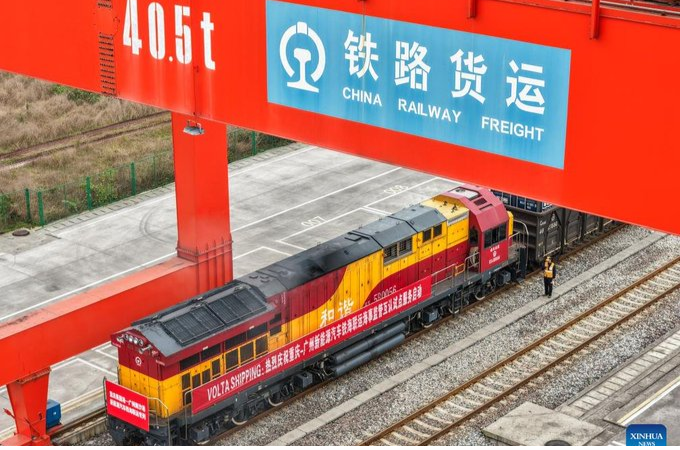
332 Million Tonnes: China’s Rail Freight Hits January Record as 2026 Industrial Demand Surges
China’s vast railway network began the year on solid footing, transporting 332 million tonnes of cargo during January 2026 — a steady 1.6% rise compared to the same month in 2025.
The figure, shared by state-affiliated outlets including People’s Daily China on social media, reflects continued strength in industrial activity, logistics reliability, and the movement of essential goods despite ongoing global economic headwinds and supply chain shifts.
Freight railways remain the backbone of China’s bulk commodity transport, carrying roughly 80% of the nation’s coal supply (critical for electricity generation and heavy industry), along with large volumes of iron ore, steel products, grain, construction materials, and other industrial inputs. The January performance aligns closely with typical monthly volumes in recent years (generally 300 – 350 million tonnes), indicating stable demand rather than a dramatic surge.
Freight vs. High-Speed Passenger Rail – Clear Roles
While the cargo milestone focuses on conventional heavy-haul freight lines (designed for bulk goods at moderate speeds of 80 – 120 km/h), China’s world-famous high-speed rail network operates separately. By late 2025, high-speed lines exceeded 50,000 km – the longest on Earth – with trains routinely running at 300 – 350 km/h and carrying nearly 4.6 billion passengers in 2025 alone.
High-speed rail prioritizes speed, punctuality, and passenger comfort on dedicated tracks with advanced signaling (CTCS), aerodynamic train designs (Fuxing/CR series), ballastless slabs, and distributed power systems. It handles time-sensitive express freight (e.g., e-commerce parcels, electronics, perishables) on select corridors, but most heavy bulk freight moves on conventional lines to avoid disrupting high-speed schedules and to reduce track wear.
China has been testing innovations at the intersection of both systems, including synchronized “virtual coupling” for freight (multiple trains running in close coordination without physical links) and high-speed parcel trains reaching up to 350 km/h on passenger corridors. These efforts aim to boost efficiency and capacity without requiring entirely new infrastructure.
Broader Economic and Infrastructure Context
The January 2026 freight volume builds on 2025’s full-year performance of more than 5.27 billion tonnes (up about 2% from 2024). Fixed-asset investment in railways reached 901.5 billion yuan (≈$128.9 billion) in 2025, a 6% year-on-year increase, supporting new line construction and upgrades. Over 3,100 km of new track opened last year, of which 2,862 km were high-speed.
Looking ahead, China State Railway Group has set a 2026 target of around 4.402 billion passenger trips (a 3.5% increase) and plans to open more than 2,000 km of new lines. Longer-term goals include a total railway network of approximately 180,000 km by 2030 (including roughly 60,000 km high-speed) and 70,000 km of high-speed lines by 2035.
China’s rail system continues to serve as a critical engine of domestic connectivity, economic integration, urban-rural links, and industrial supply chains. The steady January performance signals resilience in freight logistics – keeping power plants fueled, factories supplied, and construction sites active – while the high-speed passenger network demonstrates technological leadership and supports broader modernization efforts.
