
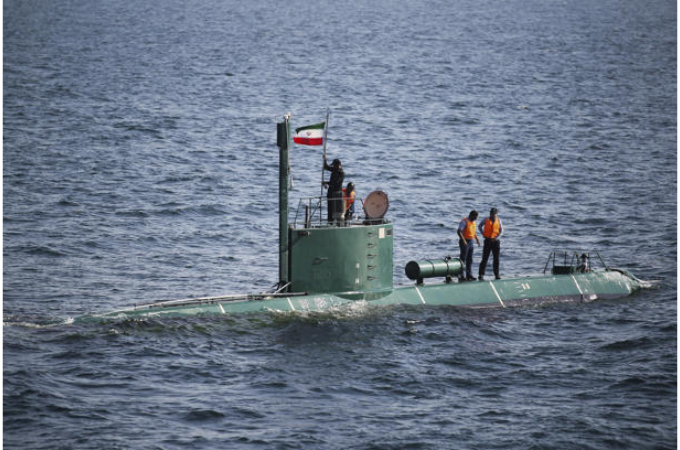
IRGC Navy Launches ‘Smart Control’ Live-Fire Drills in Strait of Hormuz Amid U.S. Tensions
Iran’s Islamic Revolutionary Guard Corps (IRGC) Navy commenced a significant live-fire maritime exercise in the Strait of Hormuz today, codenamed “Smart Control of Hormuz Strait.”
The drills, supervised directly by IRGC Commander-in-Chief Major General Hossein Salami (with field coordination by Major General Mohammad Pakpour), involve combined naval operations designed to test operational readiness, review security protocols, and simulate responses to potential threats in this vital waterway.
According to Iranian state media and reports from outlets such as Tasnim News Agency and Sepah News, the intensive exercises aim to demonstrate the IRGC’s capability to maintain absolute control over the shipping lanes in the face of “possible security and military threats.” The timing is strategically deliberate: the drills began just twenty-four hours before a scheduled second round of indirect nuclear negotiations between Iranian and US representatives in Geneva, Switzerland.
The exercise occurs against the backdrop of a substantial US naval buildup in the Persian Gulf. The Trump administration has described the deployment – headlined by the USS Abraham Lincoln carrier strike group – as a necessary “armada” to exert “Maximum Pressure 2.0” on Tehran. Informed observers interpret these IRGC maneuvers as a calculated show of force, signaling that Iran possesses the “asymmetric veto power” to disrupt global energy markets should diplomacy fail.
The Strategic Importance of the Strait of Hormuz
The Strait of Hormuz remains the world’s most critical maritime chokepoint. Connecting the Persian Gulf to the Gulf of Oman, it serves as the primary artery for oil and liquefied natural gas (LNG) from the world’s largest producers.
-
Volume of Transit: Recent data from the US Energy Information Administration (EIA) indicates that approximately 20 million barrels per day (b/d) of petroleum liquids transited the strait in 2024—accounting for roughly 20% of total global consumption.
-
Geographic Vulnerability: The strait’s narrowest point is only about 21 nautical miles wide, with navigable shipping lanes restricted to just two miles in either direction. This concentration makes the route uniquely susceptible to mine-laying, drone swarms, or land-based missile strikes.
-
Lack of Alternatives: While pipelines exist in Saudi Arabia and the UAE to bypass the chokepoint, their combined spare capacity is estimated at no more than 5 million b/d, leaving approximately 75% of the region’s exports with no alternative route.
Historical Context of Tensions
The Strait of Hormuz has long been a geopolitical flashpoint. During the “Tanker War” (1980 – 1988), both Iran and Iraq targeted commercial vessels, leading to the US-led Operation Praying Mantis in 1988, which remains the largest US surface engagement since WWII.
In more recent decades, Iran has utilized “hybrid warfare” tactics, including the seizure of the MSC Aries in 2024 and the use of “suicide drones” against tankers in 2025. Following the targeted strikes of Operation Midnight Hammer in early 2025, the IRGC has shifted toward a more permanent state of “active defense,” asserting a sovereign right to oversee all transit, a claim contested by the US under the UN Convention on the Law of the Sea (UNCLOS).
Market Reaction: WTI Oil Prices
Energy markets reacted with measured caution to today’s developments. West Texas Intermediate (WTI) crude futures hovered around $63 per barrel on February 16, 2026, showing modest gains of 0.8% in early trading.
Economic Implications:
-
Risk Premium: Traders are currently pricing in a $3 – $5 “geopolitical premium” due to the proximity of the US carrier groups and the IRGC’s live-fire activities.
-
Volatility Traps: While prices are far below the 2025 peaks – which briefly neared $410 following the “Midnight Hammer” strikes – a full closure of the strait remains the “black swan” event that could trigger an immediate spike toward $120+.
-
Tug-of-War Dynamics: Markets are currently caught between a “bearish” outlook driven by high non – OPEC production and a “bullish” risk profile driven by the Tehran – Washington standoff.
As the Geneva talks proceed, the Strait of Hormuz remains the ultimate barometer for global stability. For now, the world watches to see if today’s drills are merely a standard performance of regional hegemony or the early warning signs of a broader maritime confrontation.
