
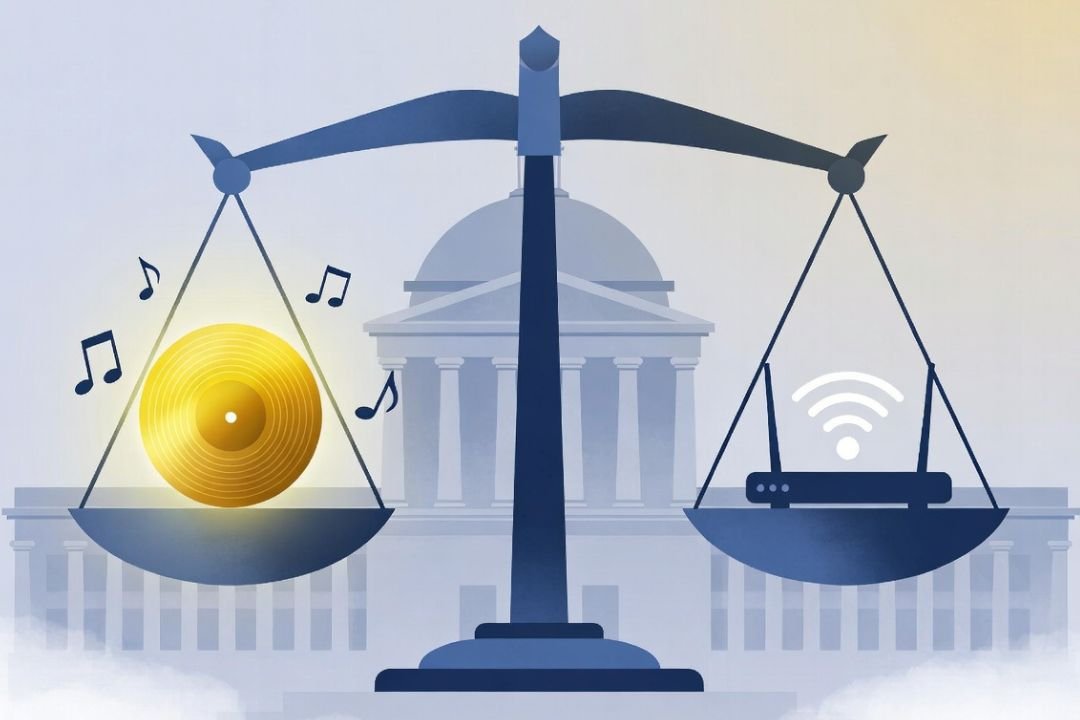
U.S Supreme Court Rules Internet Service Providers Not Contributorily Liable for User Copyright Infringement Without Intent or Tailored Service
In a significant decision clarifying the scope of secondary copyright liability, the U.S. Supreme Court ruled that an Internet service provider (ISP) is not contributorily liable for its subscribers’ copyright infringement merely because it continues to provide service to known infringers.
The unanimous opinion, written by Justice Clarence Thomas, reversed the Fourth Circuit’s ruling in the long-running dispute between major music copyright owners (led by Sony Music Entertainment) and Cox Communications. The Court held that contributory liability requires proof that the provider intended its service to be used for infringement – either by affirmatively inducing infringement or by providing a service specifically tailored to that purpose.
Sony and other music companies had accused Cox of contributory and vicarious copyright infringement because Cox subscribers used the ISP’s Internet connection to illegally download and share copyrighted music files. MarkMonitor, hired by the copyright owners, sent Cox over 163,000 notices identifying IP addresses linked to infringement over a roughly two-year period.
Cox had a policy of issuing warnings, suspending service, and eventually terminating accounts for repeat infringers, but Sony argued that Cox’s enforcement was insufficient and that the company profited from subscribers who continued infringing. A jury awarded Sony $1 billion in statutory damages after finding Cox liable on both contributory and vicarious theories. The Fourth Circuit affirmed contributory liability but reversed on vicarious liability.
Consequently, the Supreme Court held that Cox is not contributorily liable. Justice Thomas explained that the Copyright Act does not expressly impose secondary liability, and the Court has been reluctant to expand it beyond established precedents.
Contributory liability requires intent that the service be used for infringement. This intent can be shown in two ways:
Inducement – The provider actively encourages or promotes infringement (as in MGM Studios v. Grokster, where companies marketed file-sharing software as a tool for piracy).
Tailored service — The service is not capable of substantial noninfringing uses (drawing from Sony Corp. v. Universal City Studios, the Betamax case, where the VCR was capable of substantial lawful uses such as time-shifting TV programs).
Mere knowledge that some users will infringe, or failure to take stronger preventive measures, is insufficient for liability.
The Court found that Cox neither induced infringement nor provided a service tailored to it. Cox’s Internet access service has obvious and widespread noninfringing uses. Cox also took steps to discourage infringement through warnings and terminations, even if Sony viewed those efforts as inadequate.
The Fourth Circuit’s broader standard – that simply continuing to provide service to known infringers is enough for contributory liability – went beyond the Court’s precedents and was rejected.
The decision also addressed the Digital Millennium Copyright Act (DMCA) safe-harbor provisions, noting that failure to qualify for safe harbor does not automatically create liability; it simply means the provider cannot rely on that defense.
This ruling provides important clarity and protection for Internet service providers. It limits the circumstances in which ISPs can be held secondarily liable for the copyright infringements of their users, emphasising that liability requires affirmative intent or a service specifically designed for infringement.
For copyright owners, the decision reinforces that the primary avenue for enforcement remains direct lawsuits against individual infringers, though the practical challenges of pursuing widespread online infringement remain.
