
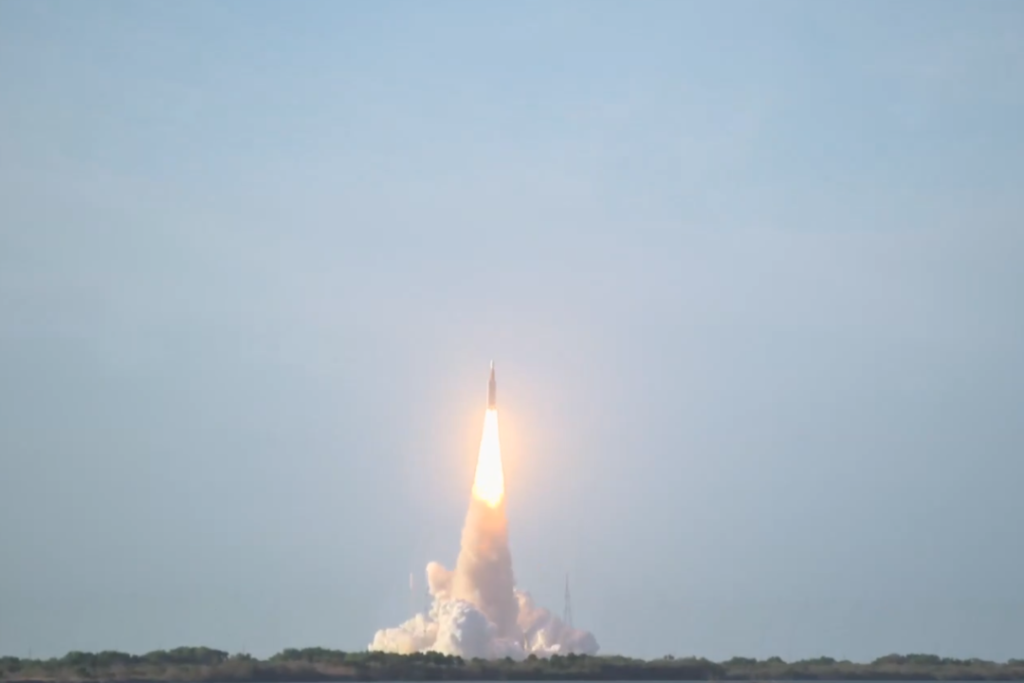
Artemis II Launches Successfully: NASA Sends First Crewed Mission to the Moon in Over 50 Years
NASA’s powerful Space Launch System (SLS) rocket lifted off successfully from Launch Complex 39B at Kennedy Space Center at 6:35 p.m. EDT on April 1, 2026, carrying four astronauts on Artemis II – the agency’s first crewed mission to the Moon since Apollo 17 in 1972.
The approximately 10-day test flight will send NASA astronauts Reid Wiseman (commander), Victor Glover (pilot), and Christina Koch (mission specialist), along with Canadian Space Agency astronaut Jeremy Hansen (mission specialist), on a free-return trajectory around the Moon aboard the Orion spacecraft.
This mission is designed to validate critical deep-space systems, life support, navigation, and re-entry capabilities needed for future crewed lunar landings and eventual human missions to Mars.
A Dramatic Liftoff and the Journey Ahead
Spectators along Florida’s Space Coast and viewers worldwide watched as the 322-foot SLS rocket, powered by nearly 9 million pounds of thrust from its core stage and twin solid rocket boosters, roared into the twilight sky. The launch occurred within the two-hour window that opened at 6:24 p.m. EDT, following a smooth countdown with no major technical issues reported.
After separation from the SLS, Orion will perform two orbits of Earth to test systems before embarking on its lunar journey. The crew will fly a figure-eight free-return path that takes them beyond the far side of the Moon – farther from Earth than any humans have traveled since the Apollo era – before the spacecraft swings back for a high-speed re-entry and splashdown in the Pacific Ocean.
No lunar landing is planned; Artemis II is explicitly a shakedown cruise to confirm that SLS, Orion, and associated ground systems are ready for crewed operations in the harsh environment of deep space.
The Crew: Experienced Astronauts and International Partnership
- Commander Reid Wiseman (NASA): A retired U.S. Navy captain and former chief of NASA’s Astronaut Office, Wiseman previously flew aboard the International Space Station in 2014. He brings command experience and engineering expertise to the mission.
- Pilot Victor Glover (NASA): A U.S. Navy captain and test pilot, Glover was the first Black astronaut to live and work long-term on the ISS (2020–2021) and flew on SpaceX’s Crew-1 mission. He is the father of four.
- Mission Specialist Christina Koch (NASA): A record-holder for the longest single spaceflight by a woman (328 days on the ISS), Koch is an electrical engineer with extensive extravehicular activity (spacewalk) experience.
- Mission Specialist Jeremy Hansen (CSA): A former fighter pilot and the first Canadian assigned to a lunar mission, Hansen represents strong international collaboration under the Artemis Accords.
The diverse crew – three Americans and one Canadian – embodies the global nature of NASA’s Moon to Mars campaign.
Why Artemis II Matters
Artemis II builds directly on the uncrewed Artemis I mission in 2022, which successfully tested SLS and Orion without a crew. This flight focuses on human factors: how the spacecraft performs with astronauts aboard, how life-support and communication systems hold up millions of miles from Earth, and how the crew interacts with Orion during the high-stakes phases of trans-lunar injection, lunar flyby, and Earth re-entry.
Success here clears the path for Artemis III (targeted for 2027 – 2028), which aims to land astronauts near the Moon’s South Pole using a human-rated lunar lander. Subsequent missions will establish a sustainable lunar presence, including habitats and resource utilization, serving as a proving ground for Mars exploration technologies.
The program emphasises scientific return – studying the lunar South Pole’s water ice and permanently shadowed regions – while fostering commercial and international partnerships. Canada, through the CSA, contributes the Canadarm3 robotic system for future Gateway lunar outpost operations.
It has been 53 years since Apollo 17’s Gene Cernan and Harrison Schmitt left the lunar surface in December 1972. Artemis II revives crewed deep-space exploration with modern technology: a more powerful rocket than the Saturn V in some metrics, advanced avionics, and a spacecraft designed for longer-duration missions.
As the Artemis II crew journeys around the Moon, mission controllers at Johnson Space Center in Houston will monitor every system. The astronauts are expected to conduct tests, capture imagery, and share perspectives from a vantage point few humans have experienced.
Upon safe return, data from this mission will refine hardware and procedures for the landings to follow. NASA’s ultimate goal: establish a long-term human presence on the Moon by the late 2020s, then use that experience to send astronauts to Mars in the 2030s.
For now, four pioneers are en route to the Moon, carrying the aspirations of a new generation of explorers.
