
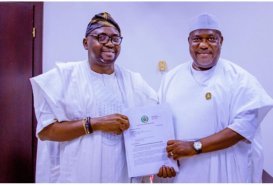
Adebayo Adelabu Resigns as Minister of Power to Contest Oyo Governorship
Nigeria’s Minister of Power, Chief Adebayo Adelabu, has formally resigned his position to enable him pursue his ambition to become the next governor of Oyo State.
In a resignation letter dated April 22, 2026 and addressed to President Bola Ahmed Tinubu, Adelabu stated that his resignation would take effect on April 30, 2026. The development puts to rest months of speculation about his political plans after he missed an earlier deadline set by the President for appointees interested in elective positions to step down.
Adelabu also used the opportunity to recommend the creation of a Coordinating Minister for Energy. He argued that such a position would provide stronger oversight and ensure better coordination across the power, gas and related sectors to sustain and build on recent gains in the electricity industry.
Confirming the resignation, the Special Adviser to the Minister on Strategic Communications and Media Relations, Bolaji Tunji, said Adelabu expressed profound gratitude to President Tinubu for the opportunity to serve, describing the experience as a privilege. Tunji added that the minister remained committed to a smooth handover process.
In the three-page letter, Adelabu outlined several achievements recorded during his tenure. These include the implementation of the Electricity Act 2023, which decentralised the power market and improved the investment climate; the integration of the Zungeru Hydropower Plant and rehabilitation of thermal plants, which helped push peak generation above 6,000 megawatts; and upgrades to the transmission grid under the Presidential Power Initiative.
He also highlighted improvements in the distribution segment, such as better regulatory oversight, enhanced revenue collection and progress in reducing Aggregate Technical, Commercial and Collection losses.
Efforts to close the metering gap through the Presidential Metering Initiative and the World Bank-supported Distribution Sector Recovery Programme were also noted. On the financial side, Adelabu pointed to tariff reforms and a N4 trillion debt restructuring programme that increased market revenues from N1 trillion in 2023 to N2.3 trillion in 2025, thereby restoring investor confidence.
Despite these gains, the outgoing minister acknowledged ongoing challenges, including gas supply constraints, infrastructure vandalism and the need for full commercialisation of the electricity value chain. He proposed several measures to address them, such as cost-reflective tariffs with targeted subsidies, recapitalisation of distribution companies, accelerated metering nationwide, continued transmission investments and stronger regulatory enforcement.
Adelabu’s recommendation for a Coordinating Minister for Energy is intended to harmonise policy direction and execution across power, gas, water resources and environmental sectors. He believes this would improve gas supply to thermal plants, optimise hydroelectric resources and speed up renewable energy deployment. The minister said his decision to run for governor aligns with the provisions of the Amended Electoral Act.
The ex minister traced his gubernatorial interest back to 2016 when he served as Deputy Governor of the Central Bank of Nigeria. The resignation comes shortly after similar exits by other cabinet members, including the Minister of Finance and the Minister of Housing and Urban Development.
The Presidency had earlier clarified that some of those departures were voluntary resignations rather than sackings, although The Cable has exclusively reported details on what it suggests are reasons for the sack of the ex finance minister, Wale Edun.
Adelabu’s exit leaves a vacancy at a critical time for the power sector, which has seen modest improvements in generation and revenue but continues to struggle with supply reliability and infrastructure deficits.
In Oyo State, Adelabu’s formal entry into the 2027 governorship race is expected to reshape the political landscape. Political observers note that his experience in both the banking sector and as Power Minister could strengthen his campaign, though he will face stiff competition from other aspirants within and outside the ruling All Progressives Congress.
