
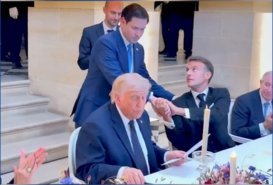
President Trump Signs Landmark 14-Point Treaty with Iran at Versailles to End War
President Donald Trump signed a 14-point Memorandum of Understanding with Iran on Wednesday evening during a dinner hosted by French President Emmanuel Macron at the Palace of Versailles, formally concluding a four-month military conflict between the United States and Iran.
The signing, which followed an earlier electronic version on Sunday, was witnessed by First Lady Melania Trump, Vice President JD Vance, Macron, and other officials. Video released by the White House shows Trump using a green pen to sign the document at a formal table. The agreement, dubbed the “Islamabad Memorandum of Understanding,” was mediated with involvement from Pakistan and Qatar.
The MoU establishes an immediate and permanent ceasefire across all fronts, including Lebanon, and commits both sides to refrain from threats or use of force. It includes provisions for reopening the Strait of Hormuz to commercial shipping, with Iran agreeing to safe passage for an initial 60 days and the US committing to lift its naval blockade within 30 days.
On the nuclear issue, Iran reaffirms it “shall not procure or develop nuclear weapons.” Highly enriched uranium stockpiles are to be addressed through down-blending under IAEA supervision, while broader enrichment limits and verification will be negotiated in a final comprehensive agreement within 60 days. The deal also provides for immediate US sanctions relief on Iranian oil, petrochemicals, banking, and insurance sectors, along with the release of frozen assets and a framework for up to $300 billion in reconstruction funding tied to compliance benchmarks.
A non-interference clause requires both parties to respect each other’s sovereignty. Implementation will be monitored, with the possibility of extensions to the 60-day negotiating window by mutual consent.
Trump described the agreement as delivering stability and economic benefits. During G7 meetings in Evian-les-Bains, he highlighted falling oil prices and said the deal opens the way for broader regional progress. Macron welcomed it as a step toward resolving the nuclear issue and advancing peace.
However, the agreement has drawn sharp criticism from several quarters. Iranian diaspora groups and opposition voices argue that the non-interference clause effectively abandons support for anti-regime elements inside Iran following reports of heavy crackdowns during earlier protests. Israel has made clear it is not bound by the deal and retains the right to act on its own security concerns, particularly regarding Iranian-backed groups such as Hezbollah in Lebanon.
The conflict began in late February 2026 with US-Israeli strikes on Iranian targets and escalated into direct exchanges that disrupted global energy flows through the Strait of Hormuz. The four-month confrontation caused significant economic and humanitarian strain across the region.
The signing caps a turbulent period that included Iranian actions prompting the initial military response, followed by intense diplomatic efforts involving multiple regional and international actors. The MoU serves as an interim framework designed to de-escalate hostilities while negotiations for a more permanent agreement continue. A formal in-person ceremony had been anticipated in Switzerland but was incorporated into the Versailles dinner.
Markets have reacted positively to the news with lower energy prices, but long-term stability remains uncertain.
