
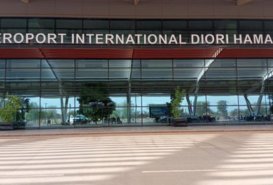
Gunfire and Explosions Rock Niamey’s Diori Hamani Airport for Second Time in Six Months
Heavy gunfire and explosions struck Diori Hamani International Airport and the adjacent Air Base 101 in Niger’s capital early this morning, marking the second major security breach at this strategically important site in under six months.
Witnesses and residents reported sustained exchanges of fire, including heavy weapons, beginning around 6:00 AM local time and lasting more than one to two hours. Videos circulating on social media show tracer rounds lighting up the pre-dawn sky. By mid-morning, the situation had been brought under control, with Nigerien security forces deploying widely, setting up checkpoints across Niamey, and reinforcing the airport perimeter.
No official casualty figures, damage assessment, or claim of responsibility have been released by the Nigerien authorities as of Thursday afternoon. Security sources described it as an apparent militant attempt to breach the airport-military complex, though details remain unconfirmed. Some local accounts suggested attackers were repelled before they could penetrate deeply.
This incident echoes a previous assault on the same location on January 28 – 29, 2026, when militants linked to the Islamic State Sahel Province (ISSP) launched a coordinated attack using small arms, RPGs, mortars, and drones. That earlier raid damaged aircraft and hangars before being repelled by Nigerien forces, reportedly with Russian support. The junta claimed 20 attackers were killed, 11 captured, and four soldiers wounded.
Diori Hamani International Airport serves as both a key civilian hub and a critical military installation. It hosts elements of the Nigerien Armed Forces, joint assets of the Alliance of Sahel States (AES — Niger, Mali, Burkina Faso), and is located near significant uranium stockpiles. The site’s repeated targeting highlights vulnerabilities in the capital, which had long been considered relatively secure compared to volatile border regions such as Tillabéri and Diffa.
The attacks come as Niger’s military junta, led by General Abdourahamane Tchiani since the July 2023 coup, continues to face escalating jihadist threats from groups affiliated with Islamic State and al-Qaeda. The junta has expelled French forces, pivoted toward closer ties with Russia, and deepened cooperation within the AES alliance, but insurgent activity has persisted and, in some cases, intensified.
Travel advisories for Niger remain at the highest level, with several countries warning against all travel due to terrorism, kidnapping risks, and general instability. The recurrence of attacks on the same high-value target raises questions about perimeter security, intelligence effectiveness, and the junta’s counter-terrorism strategy despite reinforced measures and new partnerships.
Civilian flight operations were temporarily disrupted but have largely resumed, though the area remains under heavy military guard.
