
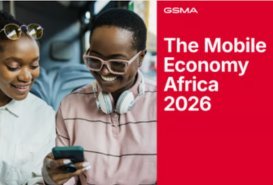
Mobile Technologies Added $240 Billion to Africa’s Economy in 2025 – GSMA Report
Mobile technologies and services contributed $240 billion to Africa’s economy in 2025, equivalent to 7.8% of the continent’s total GDP, according to the recently released GSMA Mobile Economy Africa 2026 report.
The sector supported around 13 million jobs and generated $45 billion in public revenues last year, highlighting its growing importance as a driver of economic activity, innovation, and digital transformation across Africa.
According to the report, Africa’s mobile industry is entering a new phase. After a decade focused primarily on expanding network coverage, operators are now shifting toward unlocking greater value from digital infrastructure to include deploying artificial intelligence to improve network efficiency, expanding digital services, and opening network capabilities to developers through standardised APIs. According to GSMA Intelligence, 79% of mobile operators in Africa now identify becoming digital transformation partners as a core strategic objective.
By 2030, the mobile sector’s contribution to Africa’s economy is projected to rise to $290 billion, assuming continued investment and policy support. Mobile operators are expected to invest more than $76 billion in network infrastructure between 2024 and 2030.
While mobile broadband networks now cover the vast majority of the population, a significant usage gap remains. Approximately 63% of Africans live within mobile broadband coverage but do not use mobile internet services. By contrast, only 9% of the population remains outside coverage areas.
Affordability continues to be the single largest barrier to mobile internet adoption, alongside gaps in digital skills and other social factors. The report emphasises that closing this usage gap will require concerted efforts on device affordability, digital literacy programmes, and policies that reduce the cost of data and services.
Vivek Badrinath, Director General of the GSMA, said the industry’s focus is shifting from basic connectivity to enabling broader economic and social benefits. “Africa’s mobile industry is entering a new phase of development,” he stated. “Having connected millions of people and businesses over the last decade, the focus is increasingly shifting towards unlocking greater value through AI, digital services and new forms of innovation.”
The GSMA highlighted growing momentum behind initiatives such as GSMA Open Gateway, which allows operators to expose standardised network APIs to developers and enterprises. These tools are being used to support services in financial inclusion, e-commerce, fraud prevention, and digital government.
The report also noted the importance of developing African-led AI solutions, given that the continent is home to more than 30% of the world’s languages while most current AI models are trained primarily on English and other high-resource languages. The GSMA is supporting programmes to build local data, compute capacity, talent, and policy frameworks for AI development in Africa.
The GSMA further called on governments to create enabling policy environments through investment incentives, timely spectrum allocation, measures to improve affordability, and regulatory certainty. Evidence from several African markets shows that reducing taxes on devices and digital services can accelerate adoption and expand the benefits of the digital economy.
5G adoption is forecast to reach 21% of total mobile connections across Africa by 2030, though the pace will vary significantly between countries depending on infrastructure investment and spectrum availability.
The report underscores that realising the full potential of digital technologies will require collaboration across governments, operators, technology suppliers, and development partners. It warns that without addressing affordability and skills gaps, large segments of the population risk being left behind despite improving network coverage.
