
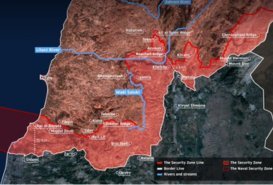
IDF Maintains 10 km Deep Security Zone in Southern Lebanon for Ongoing Anti-Hezbollah Operations
The Israel Defense Forces (IDF) has confirmed that it continues to operate within a designated security zone extending approximately 10 kilometres into southern Lebanon, citing operational needs to neutralise threats and protect communities in northern Israel.
In an official statement accompanied by a detailed map, the IDF said its troops remain deployed in the zone “due to operational requirements” and will continue “to remove threats and strengthen the defence of Israel’s northern residents.”
The security zone runs along the Israel-Lebanon border from the Mediterranean coast in the west to the Mount Hermon area in the east. It includes key areas such as Ras al-Bayada, Bint Jbeil, Tebnine, Khiam, and ridges near the Litani River. The zone encompasses dozens of villages, many of which have been largely depopulated, where Israeli forces conduct raids to dismantle Hezbollah infrastructure, including tunnels, weapons caches, and rocket launch sites.
This deployment follows a fragile ceasefire brokered in April 2026. Despite the truce, sporadic violations have continued, with Hezbollah claiming responsibility for rocket, drone, and anti-tank attacks on IDF positions in recent weeks. Israeli officials, including Defence Minister Israel Katz, have stated that the security zone will be maintained “indefinitely” until threats are fully eliminated.
The current zone echoes and modernises Israel’s pre 2000 security zone in southern Lebanon. It emphasises mobility, surveillance, and targeted operations rather than permanent static positions. Israeli forces, supported by five divisions and naval assets, focus on clearing terrorist infrastructure and creating a buffer to keep direct-fire and anti-tank threats beyond range of Israeli border communities such as Metula and Kiryat Shmona.
Meanwhile, the presence of Israeli forces has displaced thousands of Lebanese civilians north of the Litani River. Lebanon considers the zone a violation of its sovereignty, while the United Nations Interim Force in Lebanon (UNIFIL) has reported ongoing, though reduced, violence in the area.
Hezbollah has suffered significant losses – over 2,500 fighters since early 2026 according to Israeli estimates, but continues low-level harassment operations. Israel maintains that the zone is essential to prevent the group from reconstituting its elite Radwan Force and cross-border attack capabilities.
Military analysts describe the current approach as “defending forward,” relying on intelligence, technology, and rapid targeted actions to reduce long-term exposure compared to the 1982 – 2000 occupation.
