
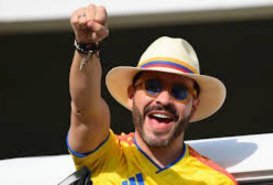
President – Elect ‘El Tigre’ Vows Salvadorean-Style Security Approach for Colombia
Abelardo de la Espriella, Colombia’s president-elect, has promised an uncompromising restoration of state authority after his decisive victory in Sunday’s presidential runoff, signalling a sharp shift away from the policies of outgoing President Gustavo Petro.
In a forceful night time speech to supporters, the 47-year-old lawyer and political outsider declared an end to what he described as an era of leniency. Speaking from behind bulletproof glass and wearing a yellow jersey associated with his campaign, de la Espriella who is widely known as “El Tigre” stated: “The time of impunity is over. The authority of the Republic will be felt once again across the entire territory.” He pledged relentless pursuit of criminals, narco-terrorism networks, and corrupt officials, drawing comparisons to El Salvador’s tough security model.
De la Espriella’s win represents a significant political realignment in Colombia. In the first round on May 31, the independent candidate from the Defensores de la Patria movement surprised many by taking 43.74% of the vote. He went on to consolidate support in the runoff, drawing moderate, centre-right, and anti-Petro voters frustrated with rising violence, record coca cultivation, and economic pressures under the current administration. Official results showed him defeating leftist Senator Iván Cepeda comfortably, with voter turnout around 58 percent.
The president-elect campaigned on a platform of “mano dura” – an iron-fist approach, including resumed aerial fumigation of coca crops, military pressure on guerrilla groups, construction of large prisons, and tighter fiscal discipline. He has ruled out negotiations with illegal armed organisations, stating that those who refuse to submit will face decisive action. De la Espriella has also spoken of closer alignment with the United States under President Donald Trump, who publicly endorsed him.
Born in Bogotá in 1978 and raised in Montería, de la Espriella built his reputation as a criminal defence lawyer and businessman before entering politics as a self-described outsider. He funded much of his campaign himself and cultivated a strong following through social media and large rallies, particularly among evangelical Christians and voters seeking greater security. His movement emphasised family values, reduced state intervention, and restoration of order.
Critics, however, have pointed to controversies in his past legal work, including the defence of clients linked to parapolitics scandals and Venezuelan businessman Alex Saab, who faces charges in the United States. Supporters counter that his experience equips him to confront systemic problems effectively. The incoming president will take office on August 7, inheriting a divided Congress where Petro’s Pacto Histórico retains considerable influence, which could complicate his legislative agenda.
Colombia continues to grapple with complex security challenges. Coca cultivation has reached historic highs above 300,000 hectares, while violence linked to armed groups persists in several regions despite Petro’s “Paz Total” peace initiative.
International observers described the electoral process as generally orderly, though initial fraud claims by Petro’s camp were later downplayed by his own candidate. The result marks a clear pendulum swing in Colombian politics from left-wing governance back toward a harder security-focused approach.
