
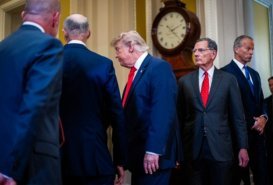
Trump, GOP Senator Clash in Heated Exchange Over Iran Conflict Funding
President Donald Trump has engaged in a sharp, high-volume confrontation with Republican Senator Bill Cassidy during a closed-door meeting with Senate Republicans, as tensions within the party over the ongoing Iran war and a newly signed framework agreement escalate.
The exchange occurred yesterday, hours before the Trump administration formally requested $67 billion from Congress as part of a larger supplemental package, to cover costs associated with the conflict that began earlier this year. Cassidy, one of four Republicans who voted the previous day with Democrats on a largely symbolic Senate resolution directing the president to end hostilities, pressed for greater transparency about the war’s progress and the terms of the deal.
According to multiple accounts from those present, voices were raised as Trump challenged Cassidy’s position. The Louisiana senator, who lost a Trump-backed primary challenge earlier this year, responded in kind, later telling reporters he “lost (his) temper” and matched the president’s tone. Cassidy emphasised that “the American people need to know more than we are being told,” noting that the conflict had extended well beyond initial expectations and that original objectives appeared unmet.
The framework agreement, signed last week, includes financial incentives for Iran, a temporary lifting of certain sanctions, and provisions to reopen the Strait of Hormuz. In return, Iran has agreed to allow shipping traffic to resume for an initial 60-day period while broader negotiations continue on issues including its nuclear programme and ballistic missiles.
The confrontation underscores deepening unease among some Republicans ahead of November’s midterm elections. A recent Reuters/Ipsos poll indicates that only about one in four Americans believes the war has been worth its costs, coinciding with a dip in Trump’s approval ratings to their lowest point since he returned to office.
The Senate’s war powers resolution, though non-binding, represented a notable rebuke, with four GOP senators joining Democrats. Late yesterday, Senate Republicans held a follow-up vote that effectively walked back the earlier measure, after Cassidy received a White House briefing from Vice President JD Vance and Special Envoy Steve Witkoff. Cassidy subsequently expressed appreciation for the session while maintaining his call for fuller disclosure.
Trump later downplayed internal divisions, criticising the initial Senate vote as sending a confusing signal to Iran. The administration’s funding request adds to the existing $867 billion defence budget and aims to replenish munitions, support operational costs, and address other classified needs stemming from months of military engagement.
Regional and Economic RepercussionsThe framework deal has eased immediate supply fears in energy markets. Benchmark oil prices fell to their lowest levels since before the conflict intensified, as the partial reopening of the Strait of Hormuz, which handles roughly one-fifth of global oil and liquefied natural gas shipments, has improved supply outlooks.
However, Gulf allies have voiced scepticism, concerned that the reconstruction fund (reportedly involving up to $300 billion) and sanctions relief could enable Iran to rebuild military capabilities without addressing its ballistic missile programme or broader regional influence. US Secretary of State Marco Rubio, speaking in Kuwait, sought to reassure partners that Washington remained committed to their security.
Separately, Israeli and Lebanese officials met in Washington to discuss a US-backed proposal for Israeli troop withdrawals from parts of southern Lebanon in exchange for Lebanese army control. Israeli Prime Minister Benjamin Netanyahu has indicated no immediate pullback, amid ongoing tensions with Hezbollah that escalated in parallel with the Iran conflict. An Israeli drone strike in southern Lebanon on 24 June was reported, with both sides offering differing accounts.
The Iran war, which began in late February 2026, has lasted far longer than initial projections of four to five weeks. It has claimed American lives, driven up global energy costs, and strained US political unity. The current 60-day negotiation window offers a potential off-ramp but leaves core disputes including nuclear ambitions, regional proxies, and long-term security guarantees, unresolved.
Critics within the GOP, including Cassidy, argue the interim accord risks strengthening Iran while weakening deterrence. Supporters of the administration view it as a pragmatic step to de-escalate after achieving partial objectives, such as restoring maritime traffic.
For now, the focus remains on congressional handling of the supplemental request and whether the fragile framework can hold through the summer negotiating period. Any resumption of major hostilities would carry significant human, financial, and geopolitical costs at a time when both Washington and Tehran appear motivated to avoid them.
